
Twenty years ago, Ingemar Ung founded this company in little Rabbalshede in Bohus County, Sweden, which is still home to our head office. A great deal has happened since then, but our basic philosophy remains the same – local action and global impact.
During 2025, we continued to develop energy parks where wind, solar and battery storage complement each other. This means more renewable energy, more stable generation and the smarter use of roads, grid connections and other infrastructure. And because we also understand that our energy parks involve infringements on nature, we take responsibility for the sites, people and the bigger picture.
New service life goals for energy parks, and sustainability targets extending out to 2035 are among the year’s most significant steps. They provide us with clear directions moving forward. We also celebrated our 20th anniversary – in Rabbalshede naturally – together with partners, landowners and others who have shared our journey. Lasting relationships, experience and faith in the future are invaluable.
For us, sustainability means long-term thinking, responsibility and a local presence. We’re confident that this is the best way to generate energy for the future. What we do today matters tomorrow.
Peter Wesslau
CEO, Rabbalshede Kraft
Value chain
An overview of the life cycle of our different energy sources – from raw material extraction to decommissioning.
Energy parks
“We always see things from a long-term perspective.”
Sustainability goals
10
climate report
Stakeholders
from Landowners to Employees
grants
11 Organizations
receive funding from the Utvecklingskraft initiative
Double materiality analysis
6 Material Topics
Anniversary
20 years
Strategy
Powering a Renewable Future
Events during 2025
We're growing in Finland
MARCH
Hei Suomi! Minna Junnikkala, our first employee in Finland, joined us. As Country Manager, she is responsible for our Finnish development portfolio.Minna Junnikkala, our first employee in Finland, joined us. As Country Manager, she is responsible for our Finnish development portfolio.
Read more about our investments in Finland here → and here →
Our first climate report
APRIL
During the year, we charted our climate impact and produced our first climate report. It provides us with a clearer picture of where emissions occur in our value chain and how we can work to reduce them.
External launch of our sustainability strategy
APRIL
Our sustainability strategy serves as a compass in our work toward achieving our sustainability goals. It is one of our most important tools. The strategy was published externally in April, allowing everybody access to it.
Read our sustainability strategy here →
Birthday celebrations where it all began
MAY
We celebrated our 20th anniversary together with landowners, partners and employees in Rabbalshede, the place where it all began. While a few guests were within walking distance, others had traveled several hours to hear Ingemar Ung talk about the location and the journey so far.
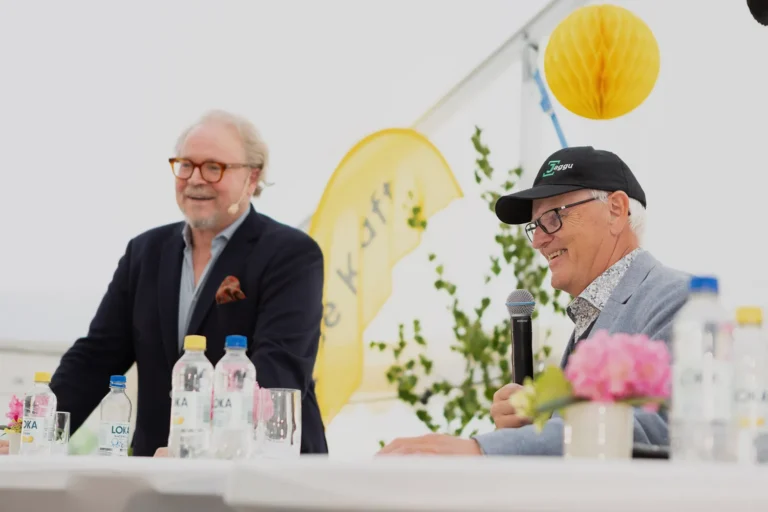
In conjunction with the celebrations, we produced a film showing Rabbalshede Kraft’s place in society yesterday, today and tomorrow. Click to watch the video →
Our first large-scale battery storage system
OCTOBER
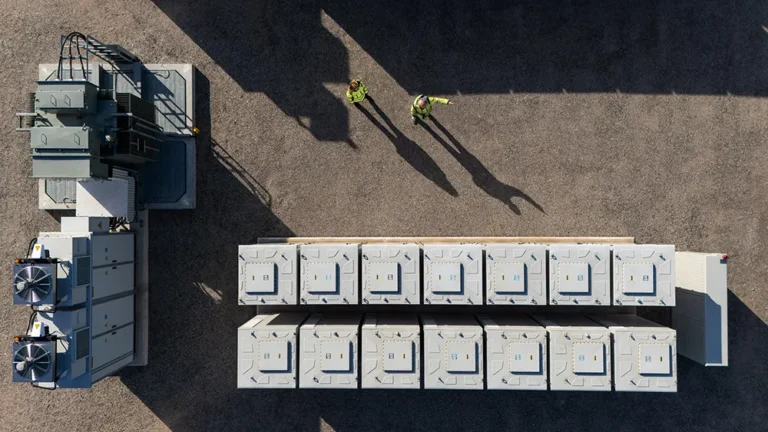
We commissioned our first large-scale battery storage system in the Femstenaberg wind farm in southern Sweden – a 20 MW/20 MWh installation. It was the starting gun for our first hybrid park, where wind power and battery storage work together.
Read more here ↓
Art project for students
NOVEMBER
In a design challenge involving metal, HDK Steneby’s art and design students opened our eyes to the ways in which worn-out fasteners from wind turbines can be reused. Circularity in practice!
Read more here →
Sustainability goals for 2035
DECEMBER
Long-term sustainability goals nailed down. Our goals for 2035 are based on our sustainability strategy. They include everything from circularity, climate and biodiversity to collaboration, innovation and responsible procurement.
Read more here ↓
Method
Charting Our Operations
Sustainability forms part of everything we do. It drives business value even as we establish an even more prominent position in the market.
Strategy & Governance
We know that our efforts are greater than regulations and standards demand of a company of our size. We see nothing strange in this, we see only the benefit for us as a company and for our shared future.
Our strategies and goals are without a doubt extremely well thought through, and they will help our company advance, grow and evolve for decades to come. Last year saw the launch of our sustainability strategy. We drew on CSRD and ESRS when we carried out the materiality analysis, which in turn provided inputs for our sustainability strategy. This year we took the next step and established goals showing how we will put the strategy into practice. The goals render the strategy measurable.
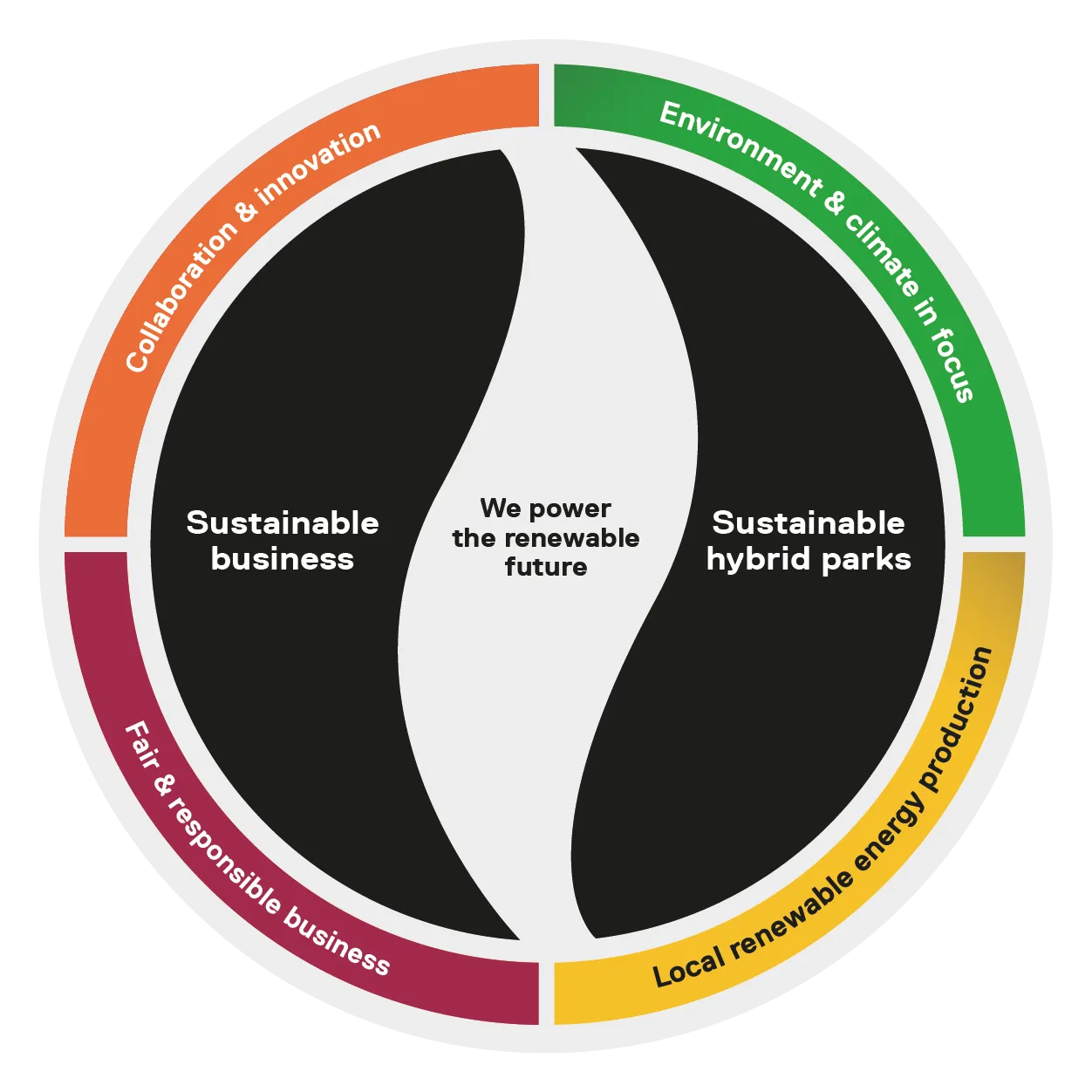
Our sustainability strategy comprises four focus areas, each highlighting important aspects of our sustainability work. Our sustainability goals are aligned with our strategy.
Division of Responsibilities
We produce renewable energy and shoulder responsibility by retaining, operating and developing our hybrid parks over time, fostering local relations and working to reduce impacts throughout the value chain. We improve sustainability incrementally by taking small steps every day in the decisions we make, the questions we pose and in the way we develop our hybrid parks.
The Board resolves on the direction of the overall strategy and regards sustainability as a tool for developing the business.
The Management Team plays an active part in this work, decides on the sustainability strategy and goals, and prepares documentation for the Board as necessary.
The Sustainability Team consists of the Heads of HR, sustainability and communication and a sustainability strategist. The team manager has overall responsibility and the sustainability strategist drives strategy work forward.
Our Employees assist through their roles and participate in the strategy work. This can involve climate data collection, responsible purchasing, due diligence, environmental permits, ISO certifications and reporting.
Sustainability Goals Aimed at 2035
During 2025, we took the next major step in our sustainability work. We have formulated goals based on our sustainability strategy to help us prioritize and establish our direction for many years to come. While our sights are set on 2035, we remain firmly rooted in our core idea – that the development of renewable energy must respect the location, the people and the future.
The goals are based on our sustainability strategy and the material area identified in the double materiality assessment. The goals will help us prioritize, strengthen the business and continue to build a brand that stands for responsibility, a local presence and renewable energy.
Our goals are
Measurable, Business-Oriented, Long Term and Material
The sustainability goals cover everything from climate and biodiversity to collaboration and responsible purchasing. The goals are determined and resolved upon by the management team and Board.
We also work with established goals in our focus area covering the Local Production of Renewable Energy. These goals are currently under development.
35
years average service life of our energy parks
10
innovative collaborative projects
upstream and downstream circularity goals
8.8
attractive employer target according to Winningtemp
0
zero tolerance for serious incidents
100%
completed supplier evaluations on sustainability requirements
1-2-3
climate impact goals in Scopes 1, 2 and 3
maintain or increase the number of species in our energy parks
5
strategic collaborations for avoided GHG emissions.
Our Sustainability Goals
Collaborations and Innovation
Service life of our energy parks
Extending the service life of our installations forms an important part of our efforts to achieve resource efficiency, circularity and a lower climate impact. The longer we can use our existing parks, the lower the need for new resources and investments. We therefore actively pursue Life Time Extension (LTE) measures to achieve a minimum average service life of 35 years for our wind and solar farms, and at least 20 years for battery storage.
Greater materials circularity
Because sustainable energy transition requires us to make smarter use of the earth’s resources and take responsibility for the full life cycle of materials, we will increase the degree of circularity in our procurements and when replacing end-of-life components based on the principles of the waste hierarchy. We prioritize recycled materials and refurbished components wherever possible, and we make sure that as much material as possible is reused or recycled. In 2026, we will assess the current situation in order to set specific values for our goals.
Intermediate goal:
2026: Measure and set baseline levels in order to establish target values and sub goals.
Innovative collaborative projects
We will establish at least 10 innovative collaborative projects to help achieve our other sustainability goals and contribute to developments in the industry. In order to find tomorrow’s solutions, we must think innovatively and collaborate with different types of players, be they other companies, academies or authorities. We had three long-term, innovative collaborative projects in 2025 that are still in progress, namely Neova, Skövde Energi och Steneby.
Intermediate goals:
2026: Two current projects.
2027: One new project.
A Fair and Responsible Company
Attractive employer
For us, a sustainable company is also a sustainable workplace – one where people develop, enjoy their work and want to stay. We believe strong, gender-balanced leadership creates a foundation for job satisfaction and low absence due to illness. We strive to be an attractive employer, and our goal is a score of 8.8 out of 10 in our internal Winningtemp temperatures by 2035.
Intermediate goals:
Annually: Employee turnover below 8%.
2030: 50/50 gender distribution in executive positions.
2030: 9/10 in leadership according to Winningtemp.
2030: Short-term absence due to illness lower than 1.5%.
2030: Long-term absence due to illness lower than 2.0%
Safe workplaces
For us, the most important thing is that everyone who works in our energy parks returns home safely every day, and that we leave nature just as we found it. Our vision of zero accidents and environmental harm is uncompromising. We accept no workplace accidents, injuries, significant environmental accidents or any breach of our conditions.
Intermediate goals:
Zero workplace accidents (LTI).
Zero injuries without sick leave.
Zero cases of serious environmental harm or breaches of our conditions.
Zero significant environmental accidents.
Responsible purchasing – risk management
In order to understand and manage risks in our supply chain we conduct annual risk assessments based on the industry, components/materials and country, and we constantly monitor legislation and regulations. Because it is almost impossible to exert full control throughout the value chain, we focus on minimizing risks by knowing where they exist and how to manage them.
Intermediate goal:
2026: Implement risk management processes in our value chains aimed at aligning with the OECD due diligence model.
Responsible purchasing – sustainability requirements
To ensure compliance with our sustainability requirements, we will conduct supplier evaluations for 100 percent of our purchases according to the conditions and price limits in the purchasing manual. The evaluations cover the full range of sustainability risks from the environment and climate to working conditions, and are based on our external code of conduct, in which we clarify what we expect of our partners.
Intermediate goal:
2026: Investigate opportunities for follow-up and the management of sustainability risks in existing suppliers e.g. through spot checks or industry-wide initiatives.
Environment and Climate in Focus
Collaborations for avoided emissions
Replacing fossil energy with renewables is one of our driving forces. We also invest in collaborative projects that further contribute to avoiding emissions, for example by entering markets with a higher dependency on fossil‑fuels or by supporting the transition of industrial processes to green energy. We will establish five strategic collaborations that help reduce climate emissions by replacing fossil-based electricity generation with renewables.
Intermediate goal:
2026/2027: Begin a new collaboration.
Reduced climate emissions
If we are to be a true driving force for climate transition, generating renewable electricity is not enough – we must also reduce emissions from our own operations and those of our suppliers. Because our greatest emissions are in Scope 3, we focus especially on reducing climate impact from our purchases and materials. We therefore investigate opportunities for using components with lower emissions such as green concrete and low-emission cables, and we review our emissions from land-use and purchased electricity to our energy parks and vehicle fleet.
Intermediate goals:
2026: Investigate opportunities for reducing Scope 3 emissions through the purchase of major components with lower CO₂e emissions.
2028, during the next wind farm construction project: If possible, use green concrete or low emission cables on one site.
Biodiversity in our parks
Because we want our energy production to take place with the greatest possible consideration given to local natural values, our goal is for the number of protected species in our parks to remain stable or increase following construction. In the case of new parks, we draw up plans to protect identified species, and we survey existing parks for invasive species based on Swedish Environmental Protection Agency documentation.
Intermediate goal:
2026: Survey and count invasive species in our areas of responsibility in all existing parks. New parks: Draw up a plan to protect identified species in all new-build parks in our areas of responsibility.
Sustainability Work in Practice
Step-by-step, the sustainability strategy forms part of everything we do – our working methods, goals and decisions. We break the goals down into intermediate goals and activities with clear KPIs to help them function on a day-to-day basis. The activities run for one year at a time and are linked to the relevant goals and intermediate goals.
The work is governed by several documents including our environmental policy, internal and external codes of conduct and supplier assessments according to the purchasing manual. Thus sustainability becomes part of our internal decisions and collaborations with suppliers.
Risks and opportunities are constantly monitored. We review our double materiality assessment annually. We also assess risks in the value chain in respect of industries, countries and potential suppliers.
One or more members of the management team are responsible for each sustainability goal. In 2026, we will develop an action plan for achieving these goals, and the management team will monitor progress at the strategic level.
Ecosystem
Our Place in the Outside World
For sustainability work to make a difference, we need to understand our entire value chain. A double materiality assessment according to CSRD helps us to recognize important issues and identify where we can do the most good.
Our Stakeholders
Dialogues with our stakeholders form an important part of our sustainability work. They not only enable us to talk about our business, but also to listen, learn and develop. When we share knowledge and each other’s perspectives we create better conditions for innovation, collaboration and reduced emissions in our value chain.
The table shows which stakeholders are important to us and how we maintain our dialogs with them.
Dialogs
Prioritized Areas
Landowners
Embedding and ongoing dialogs.
Authorities
Embedding and ongoing dialogs.
Through land owners, statutory consultation and the Utvecklingskraft iniative – a concept aimed at giving back to the local community.
Financiers and owners
Ongoing dialogs.
Employees
Our Value Chain
Renewable energy may well appear simple and natural, but sunshine and wind alone are not enough. Behind every energy park is a long chain of works, materials and decisions covering everything from raw materials and manufacturing to installation, operation and decommissioning.
There are serious matters to address throughout every part of this chain. They include working conditions, circularity, handling hazardous substances, GHG emissions from fossil energy, environmental impact and how waste is managed. We conduct risk analyses in our value chain to identify, minimize and manage negative impacts.
Our focus during 2025 largely concerned our upstream value chain. The biggest sustainability risks are at the very top of the chain, and because we are multiple supply chain links away, managing these risks is a major challenge. Although we have limited insights as a small player in the industry, we still take our responsibilities very seriously. If we are to play a part in building tomorrow’s energy supply we must also understand the impacts that arise along the way and how to help achieve better solutions.
Upstream
Extraction of Raw Materials
The extraction of raw materials such as lithium, cobalt and rare earth minerals takes place largely in high-risk countries where mining is often associated with social and environmental challenges. As a small operator, we lack direct contact with these parts of the value chain and are therefore dependent on the transparency inherent in our supply chain. In our supplier assessments, we emphasize such things as transparency, traceability, avoiding conflict minerals and ensuring compliance with the principles of the UN Global Compacts principles by players in our upstream value chain.
Processing and Production
Processing and refining minerals are energy-intensive operations that generate varying levels of emissions. Challenges in this stage include environmental risks, climate impact and working conditions. We can exert indirect influence by conducting thorough supplier evaluations using criteria such as working conditions, climate impact, decarbonization, supply-chain transparency, and the handling and avoidance of hazardous substances.
Manufacturing
The manufacture of components for energy production entails a risk of negative impact on the environment, climate and working conditions. We use our procurement and purchasing processes to reduce negative impact in areas such as our carbon footprint, working conditions and handling hazardous substances. We see a potential for positive influence through risk assessments, supplier collaborations and industry-specific initiatives. In order to measure and limit the climate impact of large or critical components we require product passports, EPDs or other cradle-to-installation climate impact summaries.
Own Operations
Construction and Installation
We set the highest standards when installing equipment in our hybrid parks in order to minimize safety and health risks. Also, the permitting process makes sure we give the highest consideration to the environment, local residents and businesses. Requirements are also set during the procurement process and in close collaboration with suppliers during the construction of installation and the subsequent production phase. In turn, suppliers maintain high health and safety management standards to ensure the safety of their employees.
Maintenance and Repairs
During the operational phase in our hybrid parks, we work proactively to prevent or reduce negative impact on biodiversity and ecosystems. We take protected species into account, manage invasive species and measure disturbances such as sound, light and shade, and stress the importance of chemical management. We require service contractors and suppliers to make sure people who work in our parks comply with the safety regulations in our Operating and Maintenance Manuals and the occupational safety and health plan, in accordance with Swedish legislation and industry standards.
Downstream
Dismantling, Reuse, Recycling and Disposal
We own our parks throughout their service lives, and this allows us to avoid and reduce waste by working over the long-term based on the principles of the waste hierarchy. Our work includes extending the lifetime of our installations in order to reduce the extraction of virgin materials. We follow developments in such things as the circularity of wind turbine blades and we collaborate on innovations in product development and product reuse. We recycle materials and manage waste according to Swedish legislation, and we measure our carbon footprint continuously throughout our operations.
Throughout the Value Chain
Haulage
Haulage takes place throughout the value chain and contributes to different emissions depending on the type of haulage and fuel. With the exception of one diesel-powered service vehicle, we operate electric vehicles to limit in-house climate impact. Haulage that take place upstream is presented in our climate report under the line item for purchased goods and services.
Our Value
Energy production is the final stage in our value chain. By adding a greater proportion of locally produced renewable energy, we see great potential for helping to reduce climate impact in the value chains of other players. We also strive to help avoid emissions through various project collaborations. Our parks produced 524 GWh of renewable energy in 2025.
Our parks produced
GWh of renewable energy in 2025
Footprint
Impact, Risks, and Opportunities
Because we are affected by our surroundings, and we also have an impact on them, we need to understand our value chain, reduce our negative impact and continue to build strong collaborations for more renewable energy.
Key Sustainability Issues
The double materiality assessment has helped us identify six areas of particular importance for Rabbalshede Kraft: Climate Change, Pollution, Biodiversity and Ecosystems, The Circular Economy, Our Own Workforce and Employees in the Value Chain.
Our sustainability work is governed primarily by the sustainability strategy and matters that create long-term business benefit. Also, the material areas according to the ESRS not only help us clarify our impact on people, the environment and society but also how sustainability issues can impact our business financially.
Climate Change
Impact, Risks and Opportunities:
Consequential materiality: The company’s production of renewable electricity helps reduce climate impact from the energy sector by replacing fossil energy sources, while the manufacture and installation of wind turbines and solar panels results in significant greenhouse gas emissions (CO₂e) in the value chain.
Financial materiality: Expanded renewable capacity can contribute to variable electricity prices, which entails both risks and opportunities.
How we Address the Issues:
We continued to measure our GHG emissions in Scopes 1, 2 and 3 for the second year running. We have integrated the EmissionTwin platform into the 2025 climate report. As the majority of our emissions are in Scope 3, the necessary work needs to take place in close collaboration with suppliers.
Pollution
Impact, Risks and Opportunities:
Pollution to air, water and soil is considered to be significant upstream in the value chain. The operation uses 19 materials with a major environmental impact according to SBTN’s High Impact Commodity List (HIC), including steel, iron, cement, crude oil, aluminum and copper.
Emissions of sulfur dioxide, oxides of nitrogen, polyaromatic hydrocarbons and harmful volatile organic compounds and heavy metals occur in the value chain. Also, emissions of potent greenhouse gases such as NF₃ occur during the production of solar cells.
How we Address the Issues:
We conduct risk analyses and evaluate subcontractors on an ongoing basis. In the procurement process, we demand transparency and traceability in the value chain, the exclusion of harmful substances and compliance with UN Global Compacts principles.
Biodiversity and Ecosystems
Impact, Risks and Opportunities:
The survey shows an estimated medium impact in the upstream value chain and in our own operations, mainly through extraction, production and construction. There is also a moderate risk that our operation contributes to deforestation.
How we Address the Issues:
We work to reduce negative impact through environmental analyses, risk assessments, collaborations in industry forums and supplier evaluations that focus on transparency in the value chain.
We work constantly in our own operations to avoid, limit, restore and compensate for our impact on biodiversity and ecosystems under the hierarchy of considerations.
Circular Economy
How we Address the Issues:
We follow circularity research in the industry, including how to recycle existing end-of-life turbine blades, and how to achieve a transition to blades with a higher recycling rate.
We work according to the waste hierarchy to avoid and minimize waste, increase material recycling and raise the proportion of recycled material in our components. We also work on extending product lifetimes and collaborations for reuse and restoration.
Our Own Workforce
Impact, Risks and Opportunities:
The health and safety of our employees is a matter of the highest priority, and we work proactively to identify, manage and minimize the risk of ill health and accidents. Our greatest health and safety risks occur among employees who work at great heights and with high-voltage installations.
How we Address the Issues:
We constantly apply preventive measures through procedures and processes such as the occupational safety and health policy, Code of Conduct, and the operation & maintenance manual. We also offer training, employee performance reviews and extensive wellness programs for the same preventive purposes. We also conduct surveys via Winningtemp.
Employees in the Value Chain
Impact, Risks and Opportunities:
There is a major potential for work-related risks in the upstream value chain. The value chain comprises many links, and this limits our insights. Rare earth metals, other metals and minerals are often mined in countries where reports of bad working conditions are common and workers are often poorly protected.
How we Address the Issues:
Our procurement processes include extensive supplier evaluations based on our Code of Conduct. We demand transparency and compliance with the principles of labor legislation as set forth in the UN Global Compact.
Double Materiality Assessment
We operate in a complex, changing energy industry in which solar, wind, hydrogen and battery solutions work together. Our sustainability work is governed primarily by our sustainability strategy, which is closely linked to our business and our role as a renewable energy player.
The double materiality assessment is an important tool that helps us review and prioritize sustainability matters where we have the greatest impact, or where such matters can impact our business financially. The assessment complements our sustainability strategy and provides a clearer picture of issues that are material according to ESRS.
Inside-out perspective: Consequential materiality considers how our operation impacts the environment, people and society.
Outside-in perspectiv: Financial materiality considers how sustainability issues can impact our business model, governance, market position and profitability.
The double materiality assessment was carried out according to the EU standard for sustainability reporting, ESRS. The assessment includes both consequential materiality, i.e. Rabbalshede Kraft’s impact on sustainability issues, and financial materiality, i.e. how sustainability issues impact Rabbalshede Kraft’s financial position and performance.
The entire value chain was analyzed, both upstream and downstream. The involvement of various stakeholders and the analysis of both internal data and external trends have provided a sound basis for our assessments.
All of the topics covered by ESRS have been assessed to make sure the relevant sustainability issues are considered, namely climate change, pollution, water and marine resources; biodiversity and ecosystems; circular economy; our own workforce, employees in the value chain, affected communities, consumers and end-users, and corporate social responsibility.
The results from the double materiality assessment are presented below together with our six key topics. We also describe how we identified and evaluated the most critical sustainability issues for Rabbalshede Kraft.
Due to the relatively high uncertainty concerning actual conditions in the supply chain, and because the supply chain also includes the extraction of raw materials, our work during the year sought to enhance our insights and knowledge of how sustainability impacts are managed in the value chain.
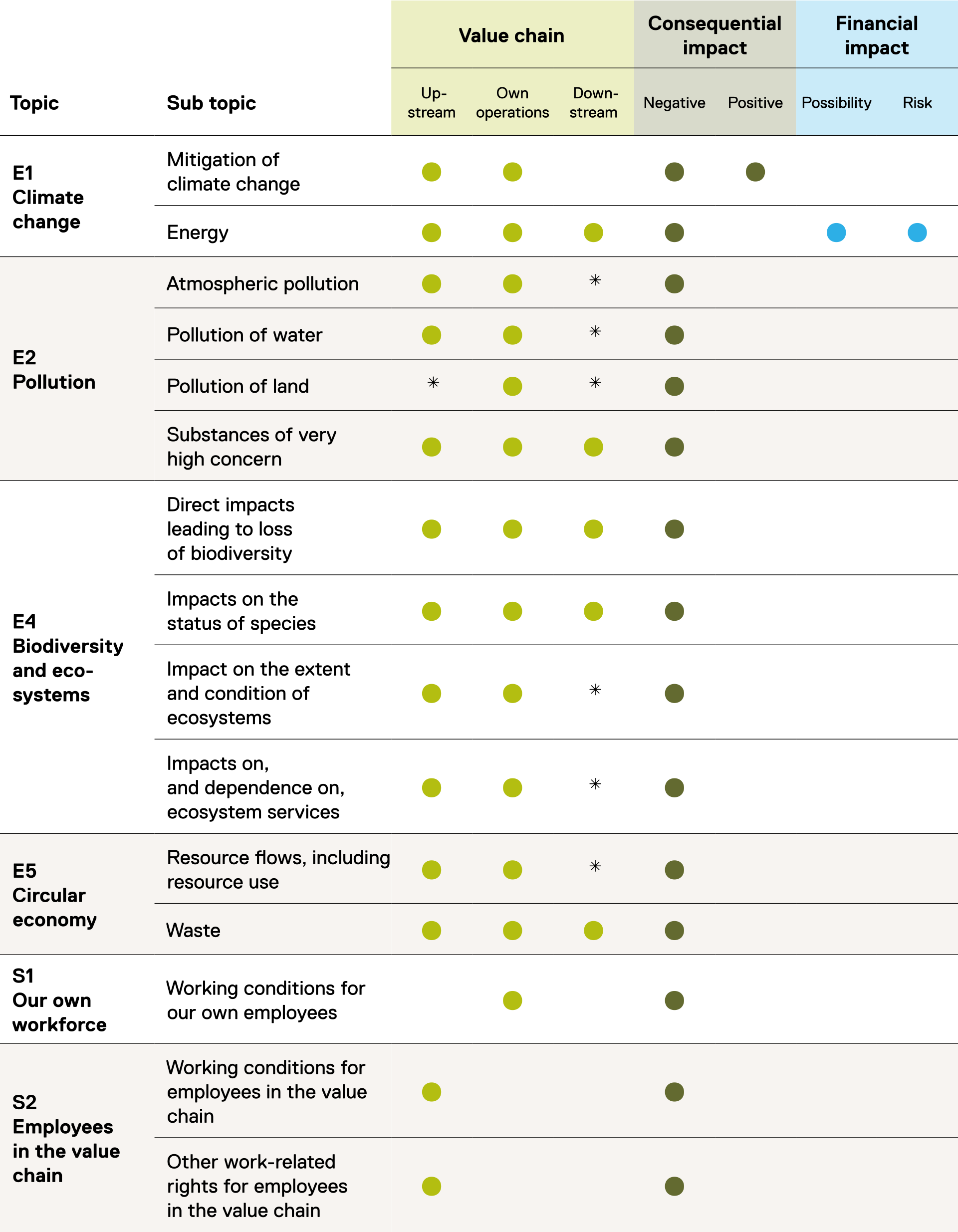
* Source material is missing
Short payback time. Long-term production.
Source: Swedish Energy Agency
0.5
year energy payback time
to produce the same amount of energy required to build a wind turbine
35
year production time
during which a wind turbine produces energy throughout its service life
Climate Report
We are publishing a climate report for the second year running. It will help us understand our own climate impact, establish measurable goals and follow up the effect of our measures. It is also a follow-up step in the double materiality assessment and is in line with our sustainability strategy. The climate report includes our GHG emissions in Scopes 1, 2 and 3.
Our CO₂e emissions during 2025 totaled 11,029 metric tons, which is around one third of our 2024 emissions.
The reduction is the result of our inclusion in 2024 of the impact from the construction of wind farms with a total of 10 wind turbines. In 2025, we included the impact from the construction of three battery storage systems in our existing wind farms.
No Data Found
As with the previous year, the largest share of emissions was in Scope 3, which accounted for 83 percent. This year, Scope 1 increased to 13.5 percent (from 3 percent in 2024), whereas Scope 2 emissions decreased by 3.5 percent as electricity purchased for our energy parks is now 100 percent renewable in practically all of our parks.
This climate report, prepared by Rabbalshede Kraft in accordance with the GHG Protocol, has been reviewed by 2050 Consulting AB, including the methodologies applied and the reported data.
Emissions 2025
Scope 1 – Direct emissions from operations
Land use
1,467
Other operations
22
Total
1,489
Scope 2 – Emissions from the production of electricity, district heating and cooling
Purchase of electricity
388
Purchase of heating
0.5
Total
388.5
Scope 3 – Purchased goods and services
Purchased goods and services
321
Capital goods
8,013
Energy and fuel-related emissions
96
Upstream haulage
476
Waste
0.5
Business travel
48
Commuting
13
Investments
184
Total
9,151.5
Scope 1–3 total
11,029
What does new electricity generation in Sweden cost?
According to the Swedish Energy Research Center’s calculations, land-based wind farms and large-scale solar power are the generation methods with the lowest production costs for new electrical generation in Sweden. Cost of new electricity generation in Sweden (öre/kWh).
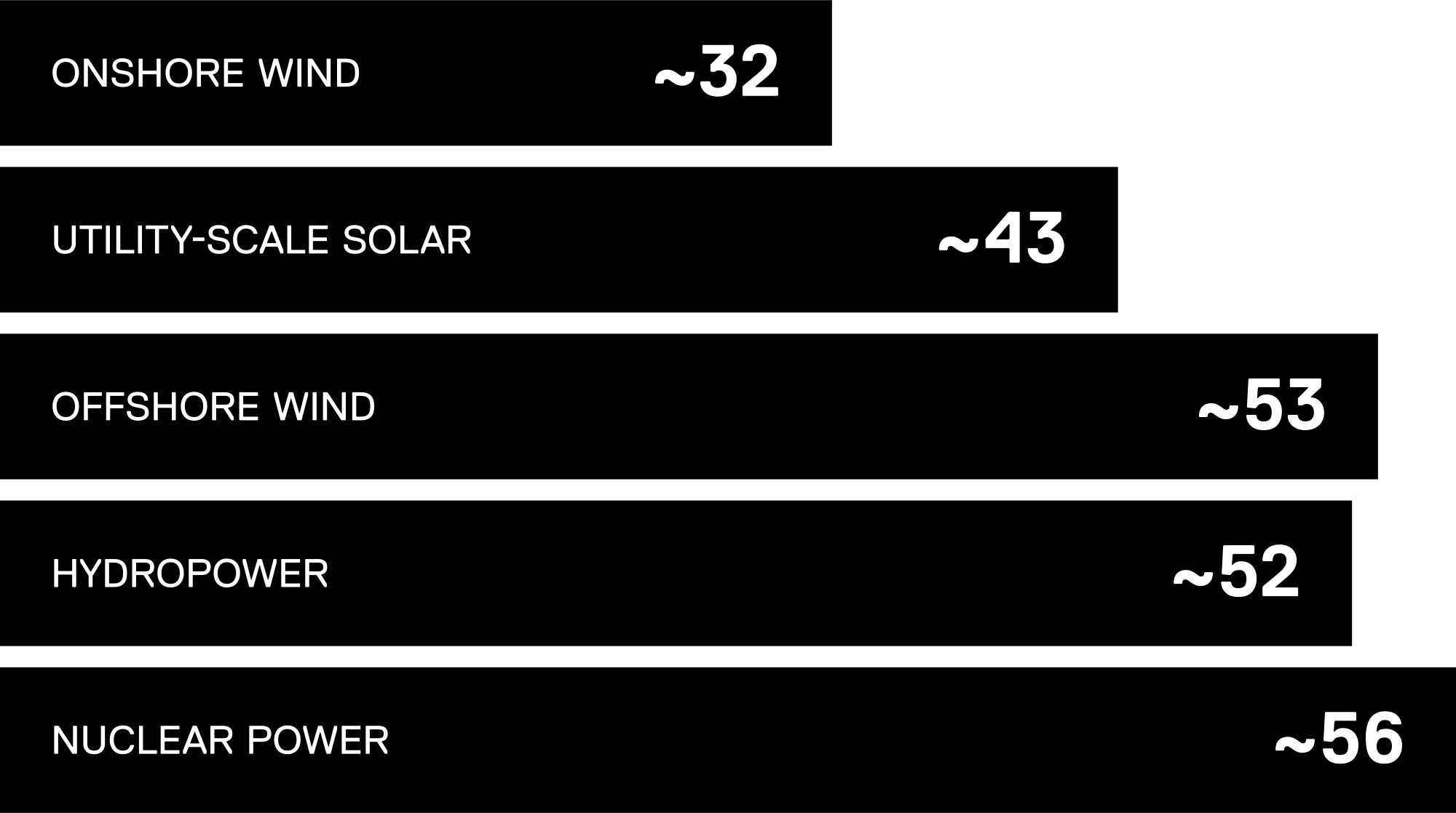
Cost of new electricity generation in Sweden (öre/kWh)
Case
Long-term and Local
When we build energy parks, we do so with the aim of staying for a long time. We own and operate the parks ourselves, which enables us to develop them over time and foster enduring relationships with landowners, local residents and stakeholders.
Tomorrow’s energy parks
We’re here to stay
Rabbalshede Kraft develops its energy parks for the purpose of owning, operating and developing them throughout their service lives, as opposed to selling them on. This is the basis of our long-term working method. Femstenaberg provides a practical example of such long-term development, where wind power has been complemented with battery storage. The next step is solar.
READ THE ARTICLE
Our goal of retaining ownership shapes our perspective from the very beginning. Technical choices must stand the test of time, agreements must remain workable, and relations with landowners, local residents and local players must continue long after a park begins operations.
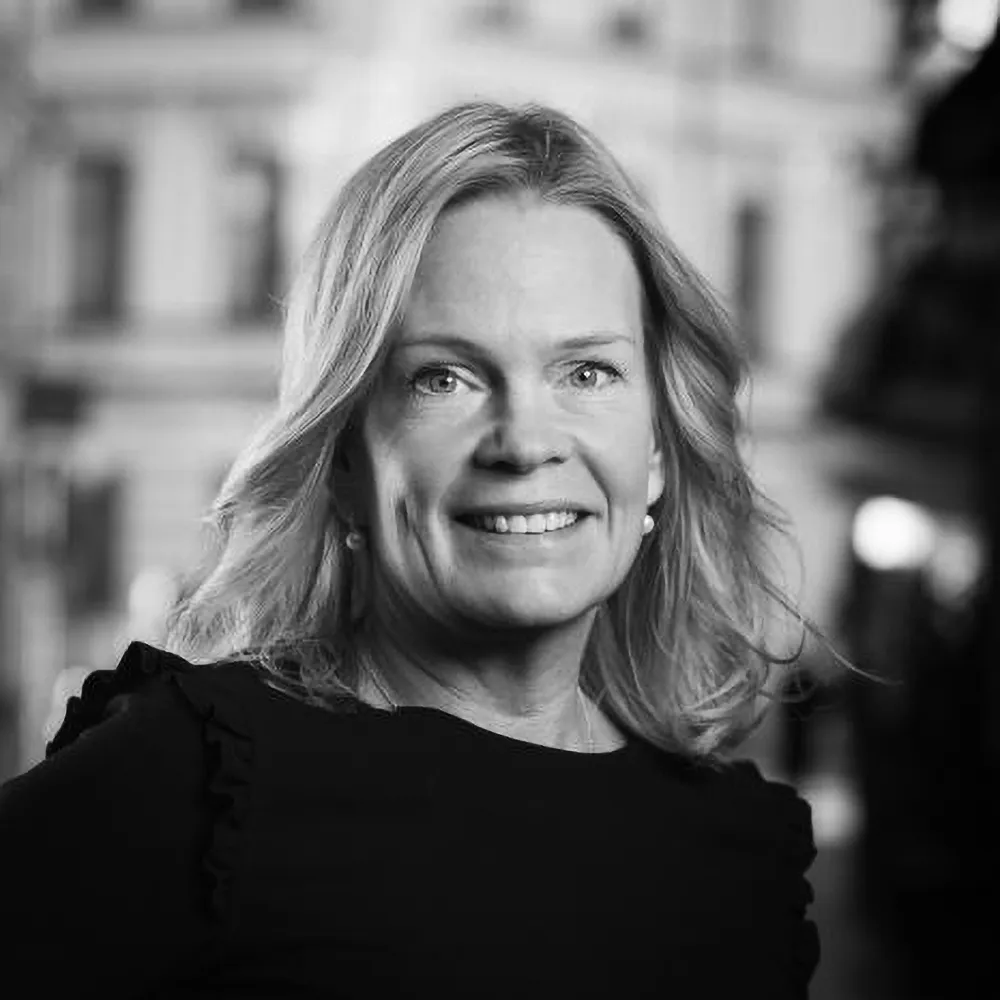
“Knowing right from the construction phase that we will be owning and operating the park for several decades makes us more inclined to foster good relations with all concerned. We like to invest in enduring solutions and fair conditions in the relevant agreements,” says Katharina Strömseng, Head of People, Sustainability and Communication at Rabbalshede Kraft.
The long-term work in all of our energy parks is of a practical nature. Our oldest wind farms were designed to last 20 years, and we are currently analyzing what it will take to extend their service lives by a further 15 years. This will enable us to achieve one of our sustainability goals, i.e. that our parks must have an average service life of 35 years.
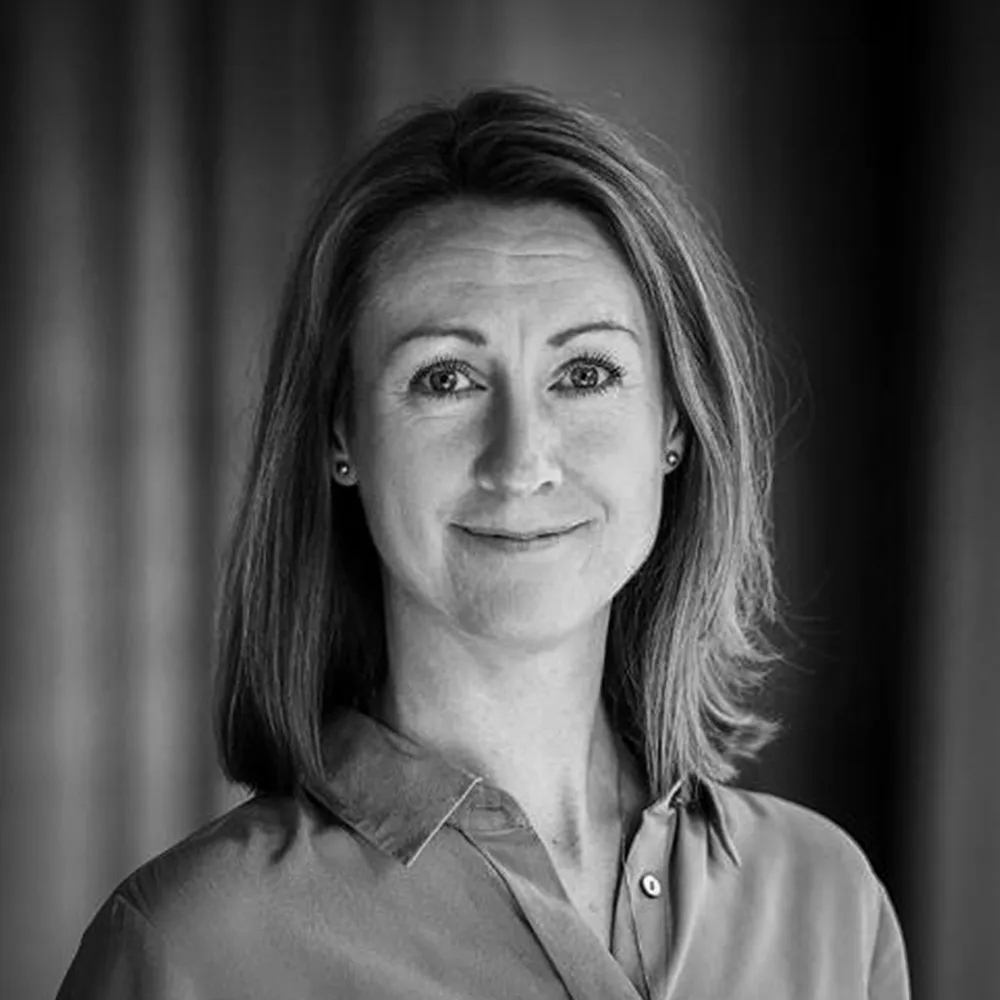
“We’re mainly looking at the foundations and towers, as they’re important parts in a life-cycle analysis. And if they don’t look like they will last there’s no point in replacing gearboxes or any of the other components up in the generators,” says Marie Magnusson.
She is the head of operations and maintenance at Rabbalshede Kraft. Her department takes over once the parks are built and in operation, and is responsible for their upkeep and development over time.
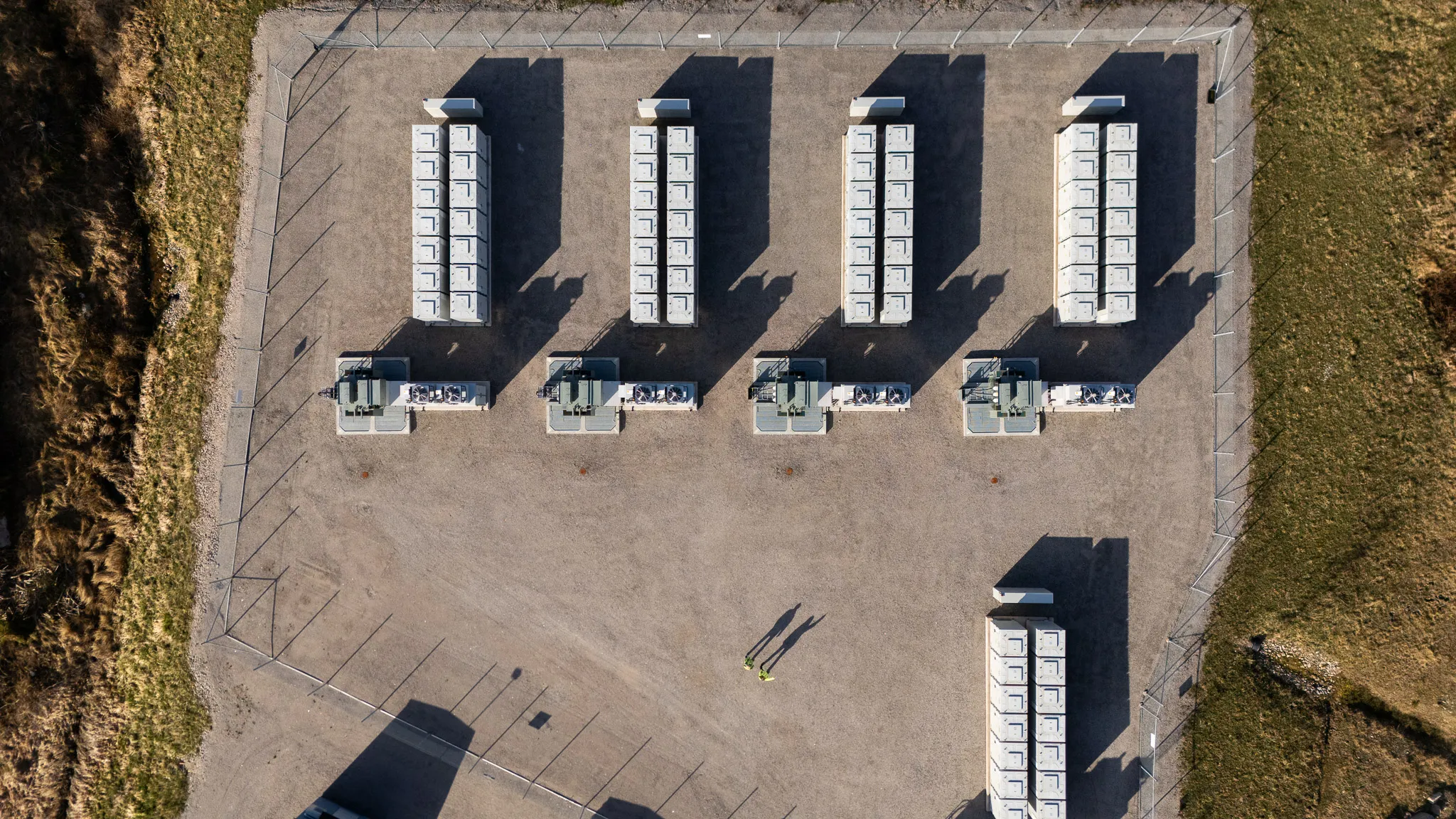
But long-term thinking is not only about extending the service life of existing parts, it’s also about developing the parks when new technology makes this possible. First up was the Femstenaberg hybrid park outside Strömstad, where the wind farm has been supplemented with a battery installation, enabling the storage of wind power. The next step will be to add a solar installation to further expand the park by making use of solar energy when there is little wind.
“Femstenaberg stands out as it’s the first hybrid park where we’ve added energy storage. But we’re busy installing batteries in several of our parks to make better use of the energy we generate and help balance the electrical grid,” says Marie Magnusson.
Femstenaberg was commissioned in 2024 and is still very new.
“Just think of all the technological advances that can be made over 35 years. Because we will operate the park throughout its service life, there’s a very good chance that technical advances will enable us to add further generating methods,” says Katharina Strömseng.
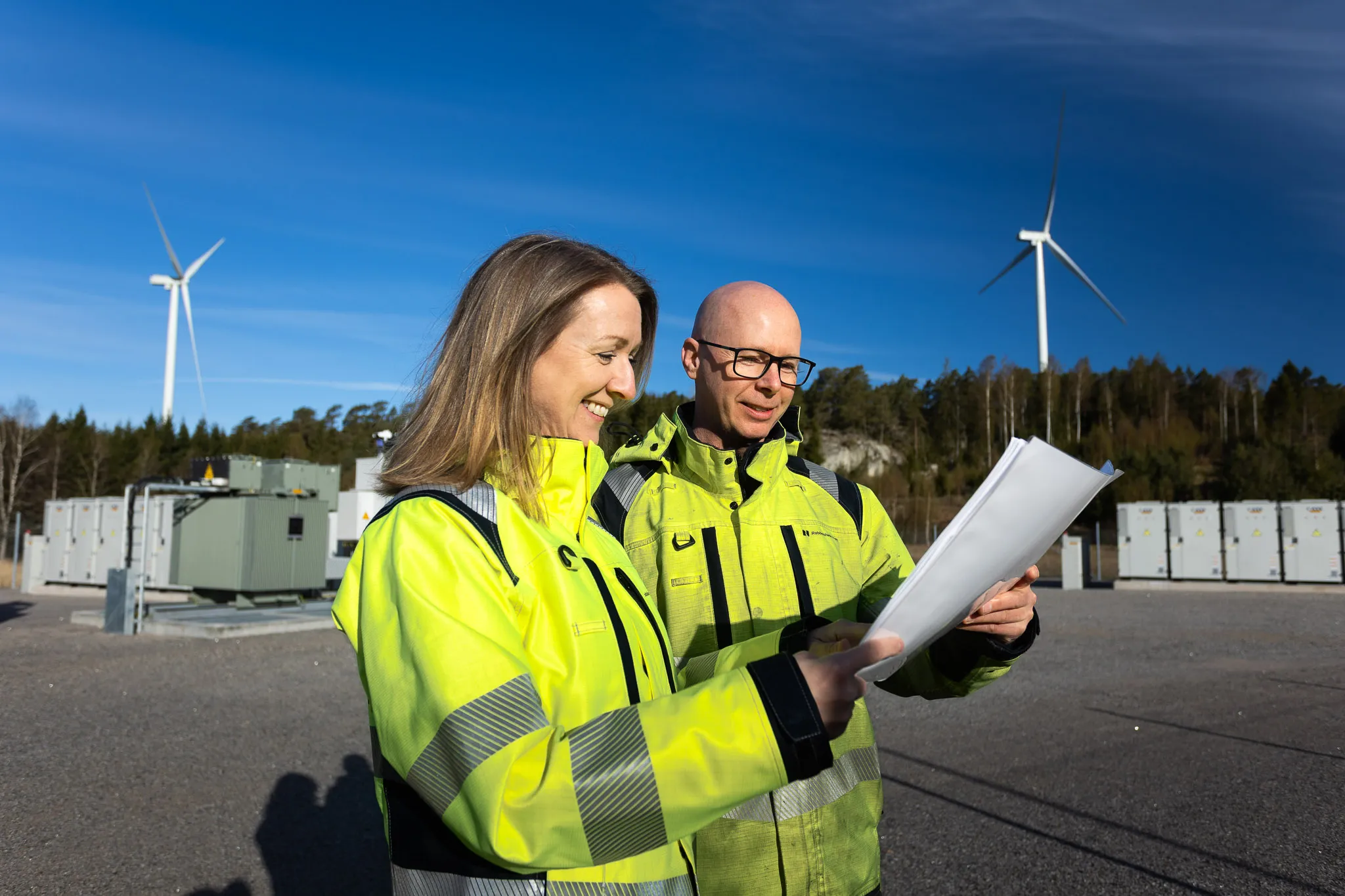
Marie Magnusson’s department – operations and maintenance – is crucial for providing the parks with conditions that allow them to last their entire planned service lives. Our employees possess high-level technical skills and the drive to find new solutions for tricky problems.
“The people in my team are all doers. They don’t give up easily, but continue pondering and considering possibilities. We always see things from a long-term perspective.”
Collaborations with people and companies around the parks are characterized by the same approach. Good, long-term relations and collaboration are a given. This applies to everything from service technicians and landowners to companies or local contacts with cutting-edge expertise.
“In our maintenance work in the parks we try to repair as much as possible, and this often means we must find creative solutions. One of our contacts is a local electrician who is skilled in precision electronics. We can turn up with a widget and he’ll troubleshoot it, reflect a while before finding a solution that lets us repair it instead of scrapping it,” says Marie.
Renewable energy is a part of Rabbalshede Kraft’s business idea, but sustainability is also about the way work is done in practice. Extending service lives, repairing more and developing the parks as new opportunities arise are different parts of the same job.
“The way the world is right now means we all need to help with the climate transition. And working sustainably also makes economic sense. Allowing wind turbines to keep turning for as long as possible instead of dismantling them and building new ones is more cost effective.
Do you want to learn more? Read about our energy parks here.
Femstenaberg in numbers
Output (MW)
Prod./year (GWh)
Other information
Wind farm
7 turbines, height 200 m
Solar park
Construction start 2027
Battery
–
Operational spring 2025
Total
Other Current Projects
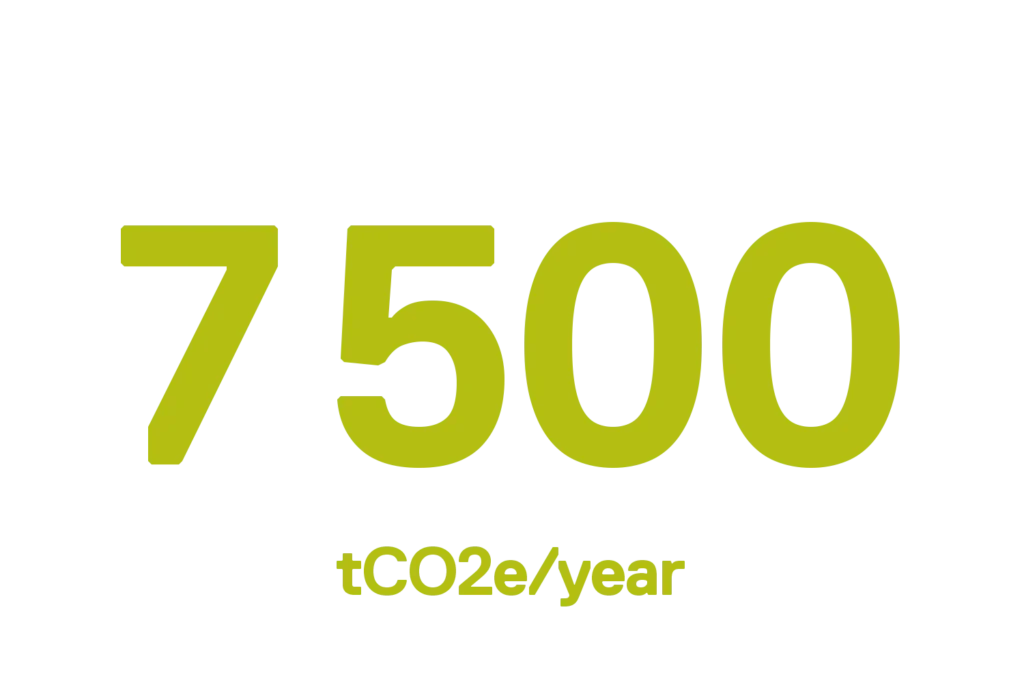
Our first two solar parks in Finland were granted more than SEK 100 million in EU support via the RenewFM program. The solar parks will help Finland avoid almost 7,500 metric tons of CO2 emissions annually.
We have started a company for green transition together with Skövde Energi. The focus will be on the production and distribution of green hydrogen, renewable power and energy storage.

How can piles of replaced wind turbine fasteners be given new life? Metalwork students tackled this challenge in a design sprint and came up with innovative, creative, and highly original solutions.
Our Work Continues
In 2025, we established long-term sustainability goals aimed at 2035. Based on our sustainability strategy, the goals will help us prioritize, strengthen our business and go on creating long-term value.
At the same time, we’re living in an age where renewable energy often encounters resistance. The permitting processes are difficult, the public debate is often hard, and the political winds do not always blow in the right direction.
Since 2019, 70 percent of new wind power projects have been refused.
In 2025, this figure was no less than 93 percent.
What more, according to WindEurope, Sweden is the country with the most social media posts in Europe containing false or misleading information about wind power. It will take more than just fine words to continue moving forward.
But we’re standing our ground. We’ll be taking our next step in 2026 with a definitive road map showing how we will achieve our goals and intermediate goals. It will include such things as responsible purchasing, robust due diligence in the value chain, greater material circularity and ongoing work with biodiversity in our parks.
And our being a long-term, local player is an important success factor for us. In 2025, we received a permit for the Brattön-Sälelund wind farm in Munkedal’s municipality.
This is especially significant in the current situation where few wind power projects gain permits. We have operated here for 20 years and own the earlier Brattön wind farm, which was completed in 2010.
The wind farm will be an important addition to renewable electricity in southern Sweden, where there is great demand for new electricity as a result of electrification, the industrial transition and an increasing demand for fossil-free energy.
We are aware that the transition will not happen on its own. It will take knowledge, endurance and collaboration. But we also know that renewable energy is the future.
And we aim to play a part in building that future.